I often get asked: how do I get the population or the target group involved in my project? As a municipality striving for citizen participation, this is often quite a challenge. I also frequently hear that attempts by the municipality to involve citizens in their projects end up fruitless.
As an action researcher, you’re actually not concerned with this issue because in such a process, the same population determines the form and execution of a project. So, you don’t need to get them on board because they are already participating, driven by their own intrinsic motivation. After all, it’s their own project!
Is your problem also their problem?
As the starting point of any action research, we first determine with the various stakeholders how they define the problem or situation. Sometimes that means that as a municipality, you have to choose a different starting point. Exciting, but worth it!
An example.
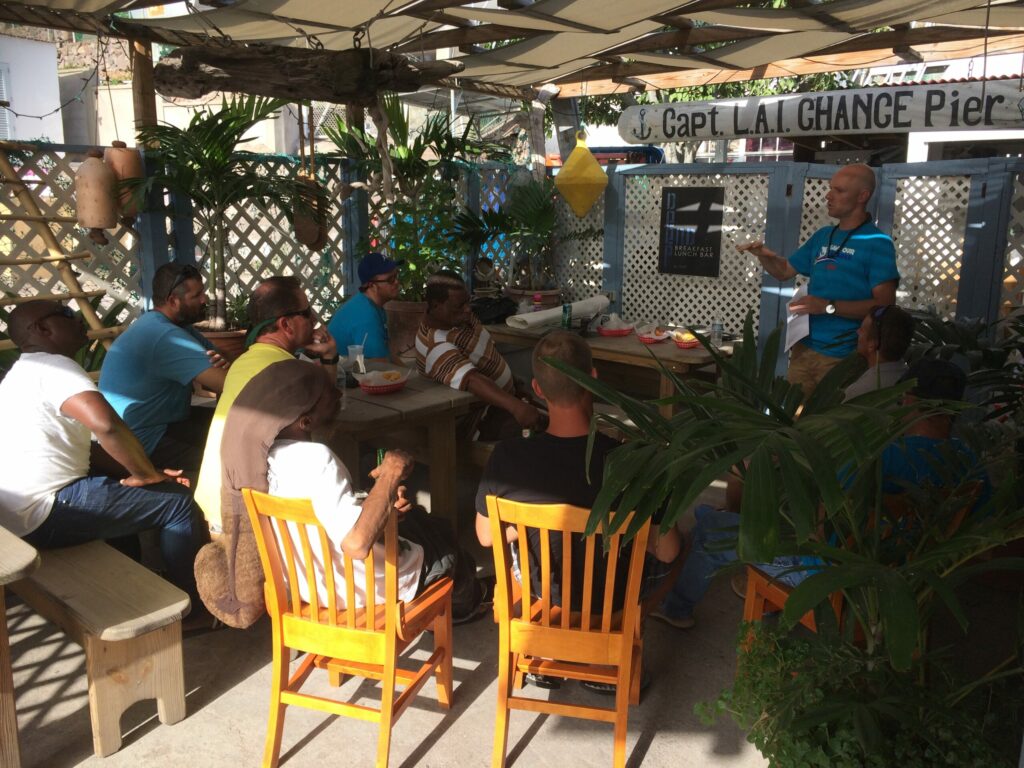
I remember well that a client wanted to protect sharks from extinction around the Dutch municipality of Saba (in the Caribbean). However, especially the local fishermen turned out to dislike sharks! Attempts such as distributing leaflets explaining the importance of sharks were unsuccessful. Sharks are troublesome creatures for them: they eat their fish and ruin their fish traps. Therefore, the starting point became the marine ecosystem instead of the sharks. A broader topic, where various stakeholders – including the fishermen – had much more space to indicate what they considered important. Eventually, this led to beautiful initiatives that indirectly protect the sharks (and the marine ecosystem as a whole)! If I had kept hammering on those sharks, I am sure nothing would have come of it. Also, in an action research in the L-Flat in Zeist, we chose a different starting point: from the waste problem defined by the municipality to the “living happiness” chosen by the residents (where the waste problem is part of). You can read about how that action research went here.
Exploring perspectives: there’s so much more!
The next step in action research is to explore the perspectives of the stakeholders on the subject. What causes and consequences do they see? What is the ideal situation according to them? What initiatives have been carried out in the past on this problem, and what was the effect? What is the role of the various parties, and how is their relationship? What is already going well in the community, what is abundant, what are the successes from the past, in any area? What talents and resources are already available? And most importantly… What solution directions do the different stakeholders propose? Taking the time to explore this thoroughly is a huge advantage over drawing conclusions from your desk or a quick residents’ meeting. You not only build a relationship with the residents but also learn much more important information that is crucial for project success! This (and the next) is where citizen participation gets a whole different dynamic. Or, can we still call it citizen participation?!
Reflecting on the outcomes with the stakeholders: a feast of recognition and
understanding!
As an action researcher, you analyze all the information you have received from the stakeholders. Then you create a visually clear overview of the total. The next step is the action where you as a municipality can make a difference, which is actually surprisingly simple – or almost too logical: you share those results with the stakeholders. You can do this, for example, in focus group-like meetings. This gives them the opportunity to first recognize their own perspective in those results. Secondly, it gives them the opportunity to understand the perspectives (and thus the behavior and choices) of other stakeholders.
Then you determine together with them which set of solution directions is the best combination to improve the system as a whole. This way, everyone gets the chance to contribute in their own way to the greater whole (the system), which ultimately yields beautiful results for everyone! For example, the fishermen on Saba came up with a way to fish more sustainably for red snapper, which further balances the marine ecosystem – benefiting the sharks, among others: more fish = more to eat!
The next step is the action where you as a municipality can make the difference, which is actually surprisingly simple – or almost too logical: you share those results with the stakeholders. This gives them the opportunity to first recognize their own perspective in those results. Secondly, it gives them the opportunity to understand the perspectives (and thus the behavior and choices) of other stakeholders.
And what else contributes to the motivation of stakeholders?
During the later stages of action research – as solution directions become more concrete – you as an action researcher can move on to exploring the stakeholders’ prerequisites for making it a success. What do they need? This is, of course, very specific to each project. However, there are some more general factors that ensure that each stakeholder can contribute to the success of a project from intrinsic motivation. Here are a few:
- Pride: the activity increases his or her sense of self-worth;
- Dignity: the activity increases his or her sense of autonomy, independence, and competence;
- Identity: the activity is carried out by the right person (the one experiencing the problem);
- Control: he or she has a sense of control over: 1) the necessities (he/she can easily access them), 2) decisions (he/she can participate in decision-making), and 3) activities (he/she has the capacity to do it);
- Responsibility: he or she feels responsible for his/her tasks;
- Unity: he or she feels empowered and supported by the group he/she works with. Celebrating the first successes – however small – can strengthen this sense of unity.
- Place: he or she carries out his/her tasks in a safe, non-threatening environment;
- Location: the activity takes place in a location where he or she feels connected.
All these factors contribute to people genuinely enjoying contributing. And that’s where the motivation comes from!
Motivating without motivating
Together with stakeholders, you can explore which (the above and/or other) factors are at play and how they can optimize those factors together. If you notice that a stakeholder is losing motivation, you can look back at these factors. What is he or she missing? Has something been overlooked? Then it is very important, for example, as a municipality, to have a dialogue with the stakeholders about this. In action research, and your role as a municipality remains that of a facilitator, and the residents stay in the driver’s seat. This way, as a municipality, you make the transition from focusing on citizen participation to focusing on government participation. Citizens motivate each other, and the municipality jumps in where necessary. Or, in other words, motivation without motivating!