You hear it more and more often: Community-up as a variation on Top-down and Bottom-up approaches. It’s also mentioned in my handbook “Participatory Action Research: Building Together Towards a Better World”. But what does it entail? Evert Jan explains. Enjoy reading, and feel free to reach out if you have any questions!
Issues in the municipal domain are becoming increasingly complex. To address them effectively, input from both municipalities and society is necessary. Decades of working for society, however, have led to polarization in the relationship between municipalities and society. More and more often, municipalities and their societies find themselves at odds. As a result, top-down or bottom-up solutions are devised, with parties not aligned. There is a need for a different approach, and community-up provides that third way.
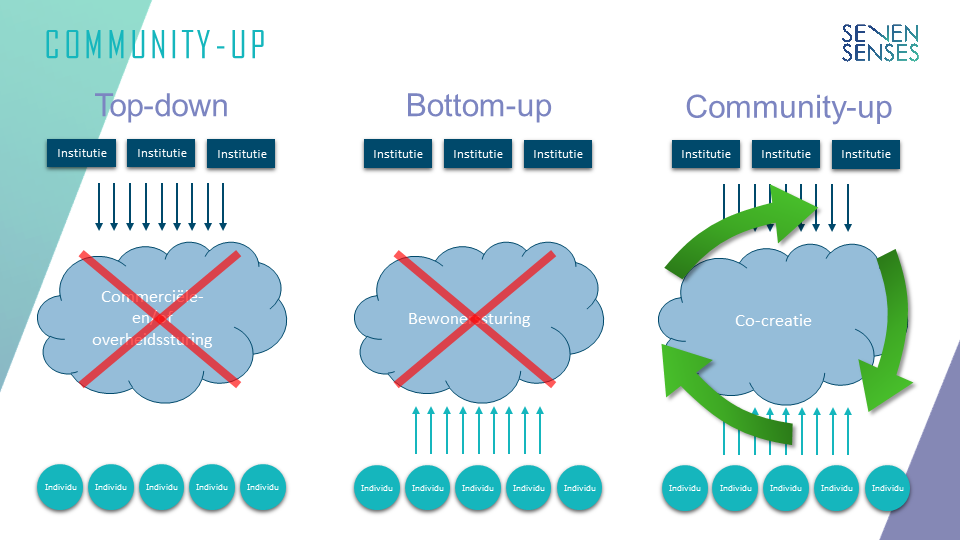
Top-down
Organizations in the municipal domain are accustomed to operating top-down. Solutions are developed based on expertise within these organizations, which are then offered or imposed on society. The problem with this approach is that the expertise present in society – for example, regarding the living environment – is not utilized. Nowadays, issues have become so complex that this expertise is indispensable.
Bottom-up
In an attempt to actively involve society, there is an increasing focus on bottom-up approaches. Society itself takes action and can effectively utilize its expertise. However, the disadvantage is that the expertise brought by organizations is no longer utilized. The role of organizations generally remains limited to facilitating the process. As a result, alongside bottom-up processes, organizations continue with their top-down approach, often leading to friction in practice.
Community-up
The solution lies in moving from either-or to both-and. Expertise is utilized from both sides. Professionals from involved organizations and people from society jointly develop and implement plans. This is what’s called community-up. Based on equality, all parties discover in a co-creation process how their perspectives reinforce each other and how each party can contribute a piece to the overall puzzle.
Common Misconceptions
Working community-up is really different from what we’re used to. However, many people look at community-up from their existing way of working, which often leads to misconceptions. Here are some common misconceptions:
“Community-up is another word for bottom-up.”
No. With community-up, “top” and “bottom” are both involved and jointly develop solutions. There is shared ownership of projects in which each party contributes a clearly defined contribution.
“Community-up means residents come up with a plan, and then the municipality foots the bill.”
No. With community-up, all involved parties jointly devise a solution and are collectively responsible from start to finish. This includes arranging any necessary budget.
Often, the municipality has the most financial resources. If these are used through a community-up process, it’s because the municipality participates in the co-creation process and discovers how their resources can be deployed in a way that optimally aligns with municipal objectives.
“With community-up, you gather needs from residents so you can better help them.”
No. With community-up, you’re not helping people. Instead, you enable residents and municipal employees, along with network partners, to discover how they can jointly develop solutions for (challenging) issues in society. Residents and organizations align their respective objectives and discover how they can reinforce each other.
“Community-up in disadvantaged neighborhoods is not realistic. Residents in difficult circumstances cannot be expected to collectively address a problem.”
No. The best way to overcome difficult circumstances is to contribute to them yourself. We have repeatedly experienced worldwide that communities have enormous power, even in challenging circumstances. It is our belief that by excluding residents from the process, the problems persist.
Fundamentally Different Way of Working
Many processes within municipalities are based on debate, while dialogue is needed for co-creation. Being open to each other’s ideas and connecting them requires an equal stance.
Additionally, many existing processes focus on maintaining control. A course is set, after which everything is geared towards maintaining that course. Co-creation requires letting go and allowing space for achieving common goals in different ways. Steering becomes more indirect: less focus on concrete output and more focus on “wholeness”, the effective functioning of the interplay between all parties.
New Opportunities in a Complex World
Issues in the municipal domain are becoming increasingly complex. To address them effectively, input from both municipalities and society is necessary. In practice, the system world of municipalities and their network partners and the lifeworld of people in society do not align well.
Community-up offers new opportunities precisely at this point. Community-up reconnects the system world and the lifeworld. By jointly exploring how a particular issue can be approached, the expertise from both worlds is used and brought together into an integrated approach in which both system parties and people from society play a role.
Because everyone is involved in the thinking process, solutions arise that individual parties would never have thought of. And because everyone contributes to the solution, all stakeholders feel ownership. That sense of ownership is the best predictor of sustainable impact!