SevenSenses operates along the lines of the BEECONOMY™ platform model.
The BEECONOMY™ platform model
Organizations within BEECONOMY™ use a specific organization model, the BEECONOMY™ platform model. This model support flocks of self-employed people to work together as If they were colleagues, while retaining their freedom.
Communities and Engagements
The BEECONOMY™ platform model supports communities of likeminded professionals – we call them: co-creators – in working towards a joint goal. At SevenSenses our joint goal is to bring Participatory Action Research all over the globe. Within these communities – at SevenSenses we call those communities: zones – co-creators will work together in so called engagements. No one will tell them to do so, it is their way to reach their goal. They start these engagements all by themselves, building on each other’s talents.
Where a community is there to stay and develops organically, engagements are typically short-term co-operations (although it is possible to setup an engagement for a longer period of time). After the goal of an engagement is reached, the engagement stops. The co-creators in that engagement will continue in new engagements within the community or somewhere else. In contrast to traditional organizations – who often forbid employees to work for other organizations in parallel – co-creators are not restricted in what to do outside an engagement or community. As long as they don’t jeopardize the goals and dynamics of the community and its engagements.
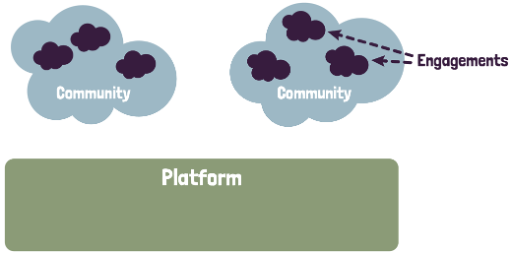
There is no top down management in a community. Co-creators can freely flock together within a community and setup an engagement when they feel they can reach a certain goal by joining forces. Nobody is telling them what to do. They are only bound by the reason for existence, the purpose of the platform organization.
Customers and contracts
No money needs to be involved within an engagement. But since co-creators thriving for a specific purpose also need to make a living, often they try to earn some money with their activities. In those cases engagements will need to have customers.
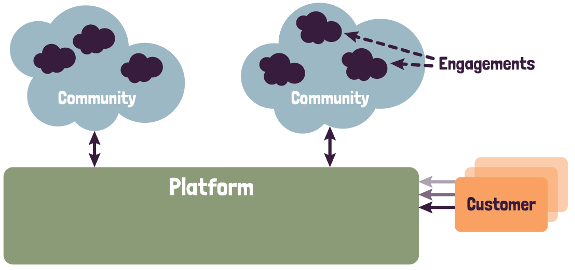
Legally it is difficult to setup contracts between customers and a flock of self-employed co-creators. That is where the platform organization kicks in. The platform organization is a legal entity which can engage in contracts on behalf of (members of) engagements.
To make this possible self-employed co-creators who join a community on the platform enter in a generic contract with the platform. This contract – which is setup to provide as much freedom as possible – regulates that when the co-creators participates in an engagement for which the platform has a contract with a customer, the co-creators is – jointly with his peers in the engagement – responsible for meeting the obligations in the contract with the customer.
Formulas
When money flows in an engagement a need arises to decide on the division of that money between the self-employed co-creators in that engagement, and the platform. This is typically decided on by the co-creators themselves.
In order to support this process the BEECONOMY™ platform model uses the notion of formulas. For this a platform distinguishes different types of engagements. Some engagements operate towards their customers on a simple pay per worked hour model. Other engagements might setup an agreement on a fixed price or even a risk-reward based model. Yet other engagements might setup an enterprise of its own, which in time will start to generate profit for the engagement.
At SevenSenses we use a generic formula for dividing income within engagements. For each type of engagement the platform derives a formula tailored to the characteristics of that type of engagement. The SevenSenses generic formula is:
- 10% of the income goes to the co-creators selling the proposition to customers
- 70% of the income goes to the co-creators delivering the proposition to customers
- 10% of the income goes to the platform
- 10% of the income goes to the SevenSenses Foundation, our tax-friendly foundation which supports projects where funding turns out to be difficult
When self-employed co-creators in a community decide to start an engagement, they first determine the type of engagement. Next they pick the corresponding derived formula as inspiration for the agreements they make. In the end they decide themselves on the actual formula to use based on mutual understanding. Basically the contribution to the platform and the Foundation is a given. However when the participants feel a need to change this contribution, they can include a representative of the platform organization in the dialogue. Together they can decide to change the platform and/or Foundation percentage as well.
Activities in the platform
Where a traditional company is focused on meeting needs of their customers, the BEECONOMY™ platform model is focused only on meeting the needs of the self-employed people in its communities. The engagements will take care of the needs of customers, each flock (engagement) in their own way.
An important aspect of the platform organization is that it cannot tell self-employed co-creators what to do, let alone tell them to stay on the platform. In order to attract co-creators and to keep them onboard, it is important to create an appealing environment for them. And those co-creators play an important role in that aspect to. For a large part the co-creators and the way they manifest themselves determine the attractiveness of the platform as a whole. Therefore – instead of working for them – the platform should work with the co-creators to create the place they want to be.
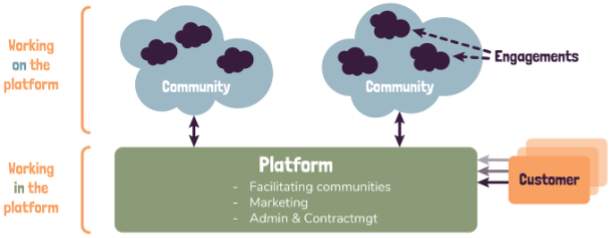
Therefor the BEECONOMY™ platform model distinguishes between activities on the platform and activities in the platform. Most of the work is done by self-employed co-creators in engagements working on the platform. The work to support the co-creators on the platform is performed by people in the platform. This is the core responsibility of the owners of the platform and initially they often do this themselves. But they can hire employees (or self-employed co-creators!) to support them in this endeavor. At SevenSenses we hire for instance a virtual assistant and a website/content manager.
The BEECONOMY™ platform model distinguishes between the following three types of activities which are performed in the platform:
- Community Management: In order to reach its goals – its purpose – the platform invests in growing a vivid community. It provides tools and organizes meetings where co-creators can easily connect and find complementary co-creators to fulfill mutual dreams. The concept of wholeness is important here. Communities are like ecosystems. Healthy ecosystems will perform optimally.
- Marketing: Investing in the way how the platform as a whole is perceived by the outside world will help twofold. First it will attract the right co-creators. Second it will help those co-creators to attract parties outside the platform they need to reach their goals.
- Administration and Contract Management: Since contracts are setup with the platform as an intermediate, and as a consequence money flows through the platform, handling this is the third vital activity of the platform.
At SevenSenses we have setup the platform to tap into ecosystems of professionals who can jointly work towards our common purpose: bringing Participatory Action Research all over the globe. SevenSenses is responsible for the work in the platform which indirectly benefits the purpose of the platform. The owners of SevenSenses also want to contribute directly to the purpose of the platform. Nothing stops them to be active on the platform as well. But there they are equal to all other professionals, taking part in the community activity and in engagements.
Online support: Beeconomy Online
At SevenSenses we use Beeconomy Online, an online platform which support the offline activities. Offline meetings allow for real in depth connection. Online connectivity allows for asynchronous communication and further IT-support.
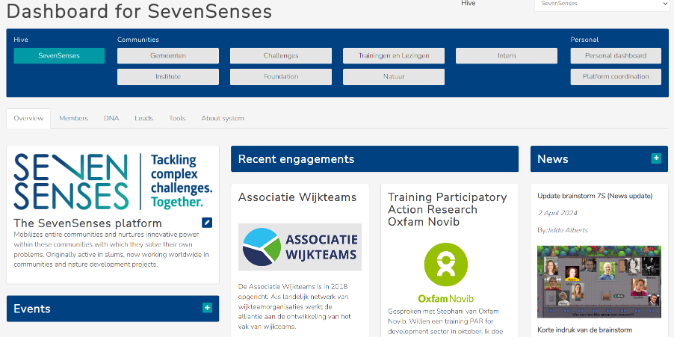
Beeconomy Online offers a wide variety of functionality to support co-creators, including:
- Discovering fellow co-creators of the platform organization and connecting with them
- Keeping co-creators up to date with newsflashes
- Corners for leads
- Corners for engagements
- Project interaction
- Personal task management
- Contract management
- Hour registration
- Invoice generation and handling