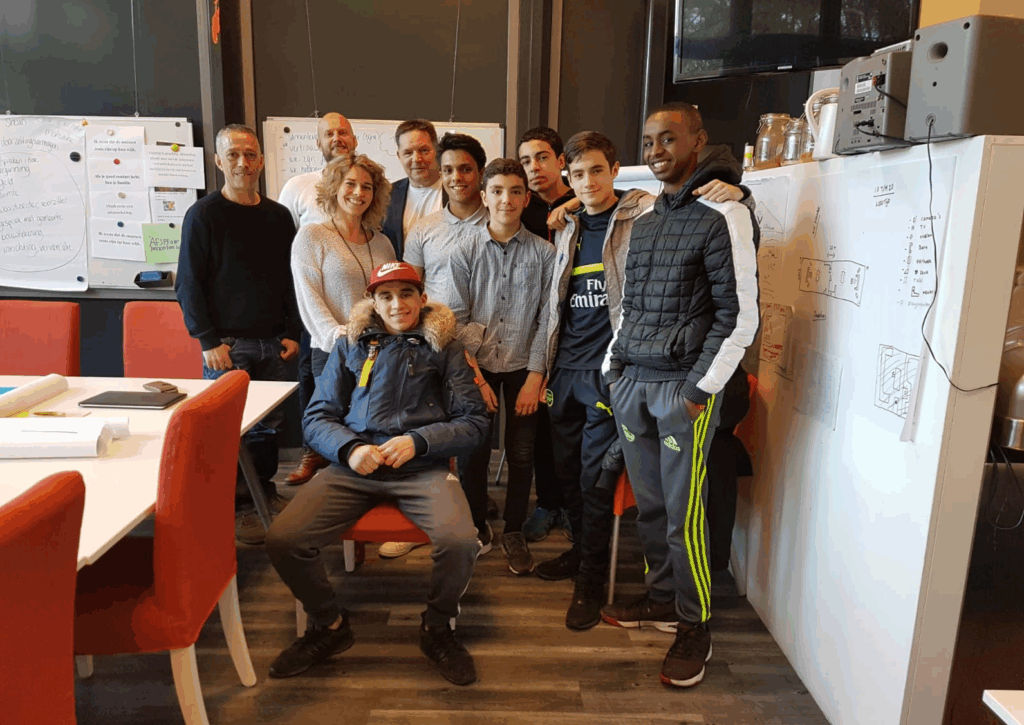
It’s time. Wil and I are ready for the focus group, which is likely to be about the community center, but nothing is certain in action research. I catch myself with clammy hands and sweaty armpits. For the first time in my action research career, I am leading a focus group with teenage boys who have been labeled by many as “troublemakers”. What can we expect from them? We glance at the clock, then at the door, and then at each other. “Are you sure they’ll come at 5 o’clock?” I uncertainly ask my colleague-action researcher Wil, from the municipality of Zeist. “Yes, I arranged to meet them here at 5 o’clock,” he says confidently, but somewhere I sense that he also doubts. Maybe this wasn’t such a good idea after all. Not even ten seconds later, they walk in. I receive a polite handshake, a ‘good day ma’am’, and the names of eight teenage boys. Pleasantly surprised by this very respectful entrance, we sit down.
Action research in the L-Flat, one of the largest gallery flats in Western Europe
Many initiatives have emerged from the action research in the L-Flat in Zeist, but none have tackled as many (mis)assumptions as the community center initiative. From the interviews we – two action researchers from 7Senses and seven employees from the municipality of Zeist – conducted with residents of the L-Flat, it often emerged that these teenage boys, while ‘hanging out’ near the entrances, cause a lot of nuisance. The boys themselves find it particularly annoying that their gatherings are seen as a nuisance, and like many residents, they suggest that a community center could solve this problem in one fell swoop. The boys would have a place to gather, and the residents would no longer be bothered by them near the entrances.
The community center initiative: the initial sketch
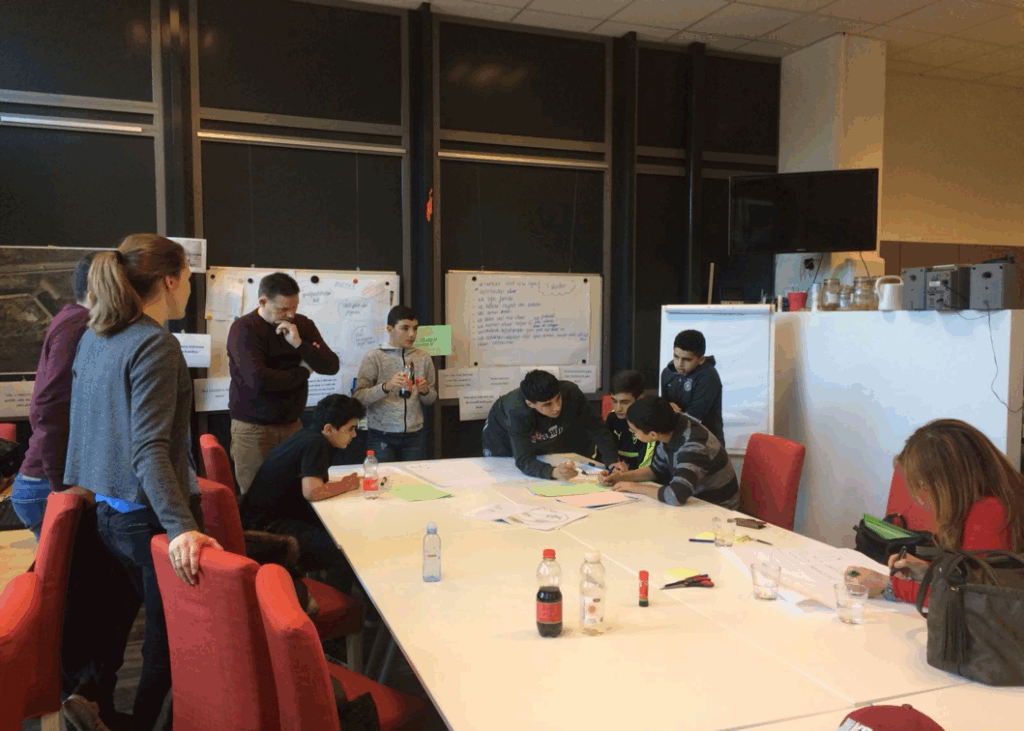
During the first focus group with the boys and Souad from the welfare organization Meander Omnium, Wil and I shared the results of the action research so far: the problems mentioned in the interviews, but also the good things, the opportunities, and the directions for solutions. We asked the boys what the most important solution was for them. They all agreed unanimously, in chorus: “THE COMMUNITY CENTER!”
Together, we looked at the talents of the youth group and how such a community center would ideally look according to them. Firstly, I noticed how many talents and other good things the boys were able to mention about themselves and their friend group. Secondly – after the boys had drawn their ideal community center – I noticed how little the boys actually need for a cool community center. As an outsider, you quickly think of a large building with multiple rooms and all sorts of amenities. The boys drew two rooms, one for the boys and one for the girls. A couch, a PlayStation, and a small kitchenette for both rooms were sufficient for the boys. Oh, and a camera, “because if something happens, we want the camera to be able to tell what happened.”
Brainstorm: what is needed for the community center?
Then, we discussed with the boys what steps were needed to realize a community center. I was surprised by the enormous collective knowledge of these boys – aged 13 to 17. They were able to determine flawlessly what needed to happen and which buildings could possibly be transformed into a community center. They also knew who they needed for the next steps. “We need to ask the district manager which of these buildings are available.” With a question to me:
“Ma’am, can we do another focus group, this time with the district manager?”
“Of course!” I said, happily surprised by this assertive move. The boys left the focus group, and a few minutes later, Wil and I came out, ready to go home contentedly. There, we met one of the aldermen, who was doing his rounds in the neighborhood to campaign for his party (it was two days before the elections). I didn’t know him, but Wil did, of course, as a colleague. I shook the alderman’s hand, to which he said:
“I just met that group of boys. What have you done with them?! I’ve never seen such a positive atmosphere around them!”
New focus group with the district manager and municipality
And so, the following week, we gathered again. This time with the district manager and some people from the municipality who were also in the know. Apart from some awkward giggling here and there, I noticed how professionally and respectfully the boys sat in the focus group. There was discussion back and forth, and at the end of the focus group, a location was determined, and new action points were established! While tidying up, one of the boys came up to me:
“Ma’am, can we talk to the neighborhood police officer next week? We would like to work with the police to establish the right rules and see how we can keep crime out.”
My mouth fell open in amazement. The boys who are said to regularly have not-so-good encounters with the police – and yes, I am aware that they are being painted with a broad brush here – are now taking the initiative to consult with the police to prevent things from going wrong.
…And then the police came
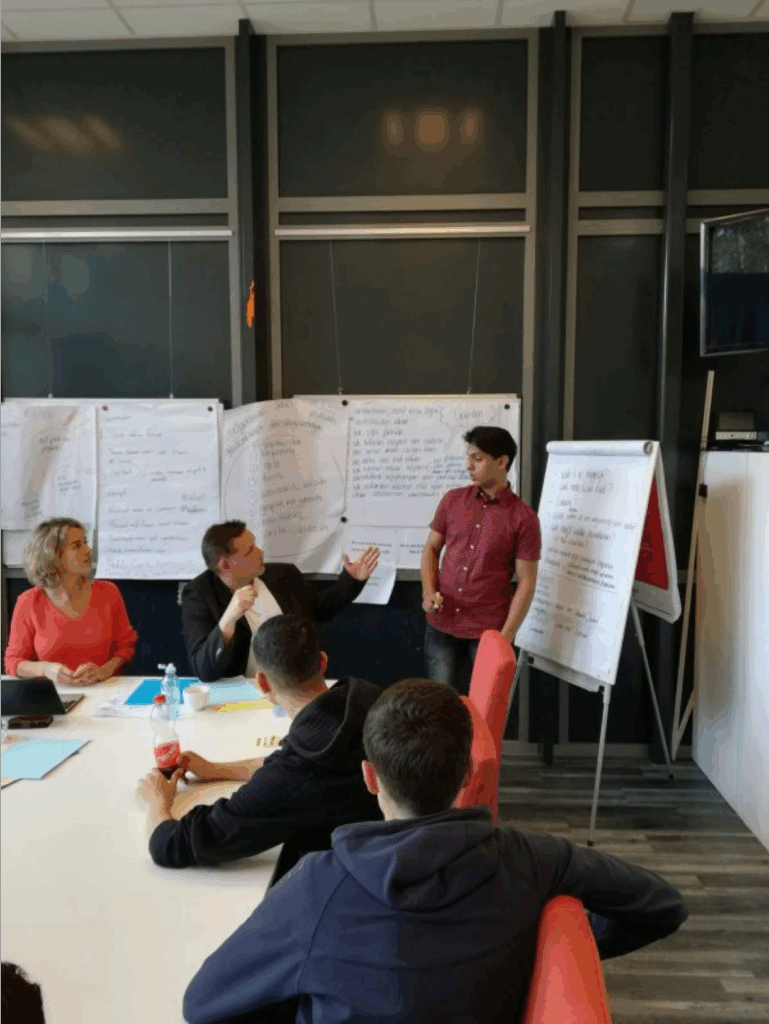
A week later, we sat down with the neighborhood police officer, the district manager, Meander Omnium, and of course, the boys themselves to follow up on the outcomes of the previous week. Because the neighborhood police officer had not previously participated in the action research, I briefly explained what action research entails. Arms crossed, a critical gaze. Throughout that focus group, I noticed he thawed, but it wasn’t because of my clumsy explanation of the project. It was the boys who were very professional here, and thus, a remarkably respectful conversation ensued! The neighborhood police officer even asked, a bit out of the blue:
“How old are you guys?! It seems like I’m talking to a bunch of adults!”
Ideas were exchanged about the location, plans were made to keep crime out, and concrete actions were taken to get closer to the community center step by step. At the end of the focus group, there were the commendable words from the neighborhood police officer and the district manager, expressing their pride in the boys for the way they handled things.
At the end of the focus group, Ismael came up to me.
“Ma’am, can we give a PowerPoint presentation about our plans for the community center at the final meeting?”
For a moment, I thought I hadn’t heard correctly, but soon I realized I was once again plagued by an assumption. This assumption was expertly smothered by Ismael’s question. Delighted and a bit too enthusiastic, I replied: “But of course, that would be great that you want to do that!” I have attended many great focus groups, but rarely have I walked out as exhilarated as I did from this one. This is why I love my job so much!
The end of the action research – the beginning of many great things
On April 10, 2018, it happened. The ‘restart meeting’ of our action research. The whole action research team had been working hard towards this for the past two months. We would present the results of the action research to the residents and other stakeholders, discuss with them the plans made so far, and hand over the initiatives that were ready to the initiators. This was to conclude our action research and as a ‘kick-off’ for the many wonderful initiatives that arose during this action research.
The principal of ‘Op Dreef’ primary school made her auditorium and classrooms available for the various breakout sessions on each theme. Soon, the school was filled up, an attendance that far exceeded our expectations. The boys were also there early, sitting coolly on the steps in the auditorium. Colleague Barry from the municipality received a comment from someone:
“Those troublemaking youths are here, they don’t belong here!” Barry responded – calm as can be – “Oh yes, they do, they are the initiators of the community center and are going to give a presentation here about their plans.” BAM! Another assumption brutally tackled.
Unfortunately, I wasn’t at the boys’ breakout session because I was leading another one, but I understood from Wil, the boys, and other involved parties that it was a very cool session. The boys gave a TOP presentation, the first two directors of the community center board – Anne Jan Odinga from Meander Omnium and Wil Verbiezen from the municipality of Zeist – were appointed, and new connections were made for collaboration. Goal: on October 10, 2018, six months after this meeting, the opening of the community center! All of this was communicated back to the public after the breakout sessions, and as if it was nothing at such a young age, the boys took the microphone to thank us, the municipality, and other stakeholders for their support.
Onwards to a cool community center in October!
A week after the meeting, the boys checked a potential building for the community center for fire safety with the fire department. And as we speak, the boys are busy with the municipality, Meander Omnium, and other stakeholders to realize this community center. The road to a community center is not easy, but seeing how the boys are stepping up now, with the support of the people around them, I have every confidence that there will be a community center on October 10! That date is already marked in my calendar. I’ll be at the grand opening!